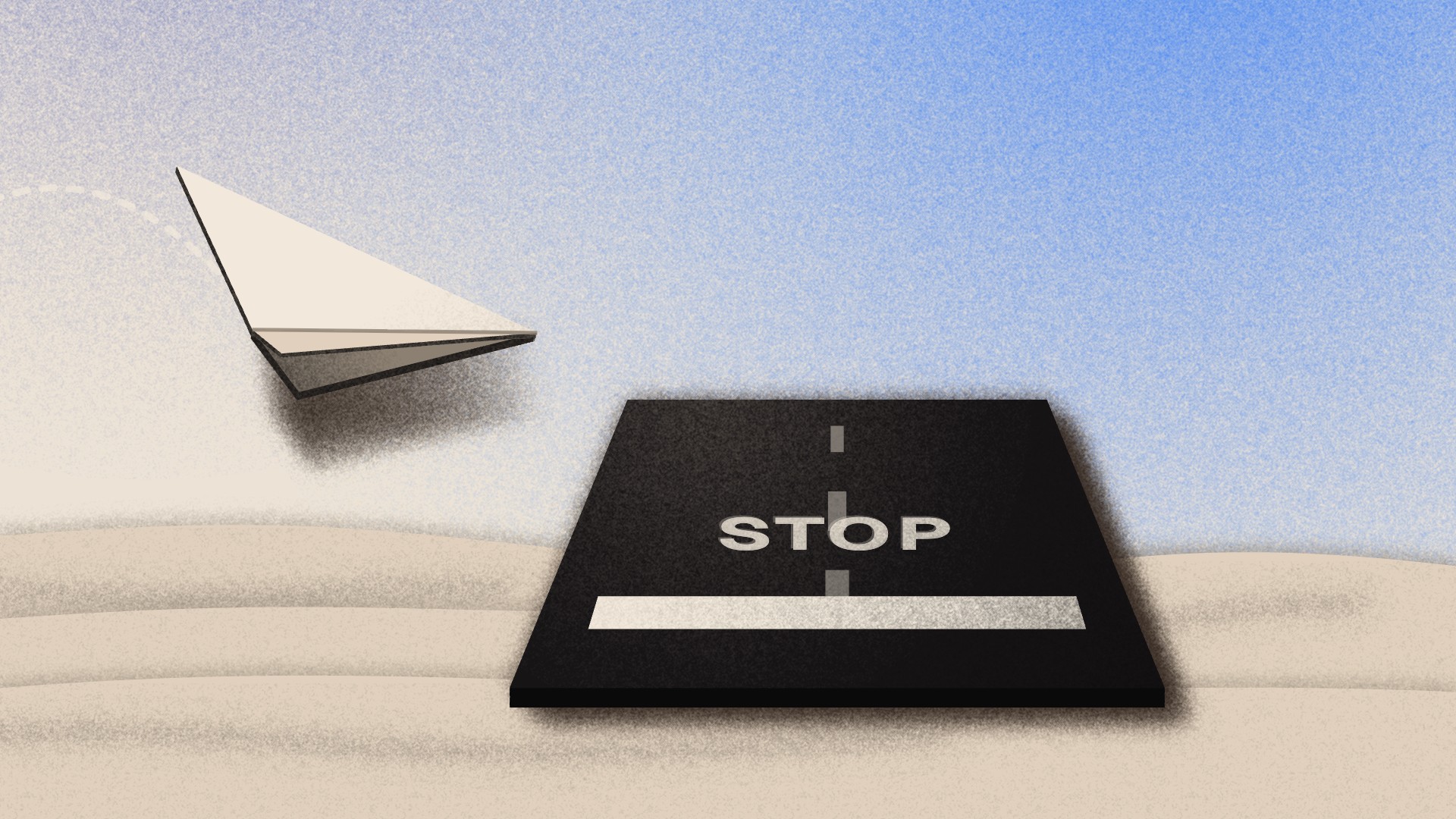
You started something. It isn't working the way you hoped, and you can't tell whether to push on or stop. The short answer: decide when you would stop before you start. Write a number, a date and a cap on what you'll spend, then keep that decision when the date comes.
By the end you'll have three things: a stop line written before money goes in, three questions for the day the date arrives, and an answer to the money you've already spent.
Seven steps set your stop line before the next dollar goes in
Step 1: Write down what has to be true
Do this. Write the two or three assumptions the idea depends on, and next to each one, the evidence that would prove it wrong.
It worked when every assumption on the page has a piece of evidence next to it that you could actually see, such as a count of buyers or a cost.
Why. Our rule: stop when an assumption the idea rests on is proven untrue, not when the work gets hard. Bezos wrote in his 2015 letter: "To invent you have to experiment, and if you know in advance that it's going to work, it's not an experiment" 1. We read that as: a new idea is a test, and a test needs a result that can fail it.
Example. Teller said X killed an automated vertical farming project because "we couldn't get staple crops like grains and rice to grow this way" 2. In our view, that is what an assumption failing looks like: the idea needed those crops to grow, and they didn't.
Step 2: Check that someone already pays for this
Do this. Find out whether anyone else is making money selling what you plan to sell. Then run one cheap demand test before you build, with the number that would make you stop written next to it.
It worked when you can name a seller who already earns money from this, or you have written down why there isn't one, and your test result sits next to a number you wrote before the test ran.
Why. Our rule of thumb: other sellers earning money is a cheap first sign that buyers exist. In our view, writing the stop number before the test runs keeps you from reading a weak result as a good one.
Example. One person trying to land a first client for a video business wrote: "I can't even seem to sell something for FREE." In our view, a result like that belongs on your page as evidence against the assumption that buyers want this.
Step 3: Imagine it has already failed
Do this. Before you start, tell everyone involved that the project has failed. Give each person a few minutes to write down, alone, every reason why. Then add any new warning signs to the list you will watch.
It worked when you have a written list of reasons for failure, and at least one of them became a signal you will check before the date.
Why. In a premortem, as Gary Klein described it in Harvard Business Review in 2007, the leader tells the team at the start that the project "has failed spectacularly", and each person writes down every reason they can think of for the failure 3. Klein wrote that the premortem "reduces the kind of damn-the-torpedoes attitude often assumed by people who are overinvested in a project" 3. If you work alone, do it with one person you trust.
Step 4: Write the kill line: a number, a date and the minimum evidence
Do this. Write one sentence: by this date, this number must be reached, after at least this much evidence (for example, this many offers made to real buyers); if not, it stops.
It worked when the sentence holds a number, a calendar date and a minimum amount of evidence, and someone else could read it and say whether it was met.
Why. Annie Duke calls the signals you decide on in advance, the ones that would tell you to walk away, "kill criteria" 4. Duke says kill criteria need a date as well as a condition: "it's not just a state of the world that you need to be identifying, it's actually a date. You need to put a deadline on it" 4. In our view, a date alone can kill an idea that never got a fair test, which is why the line also names the minimum evidence. Our rule of thumb: count different attempts, not months. The same offer repeated for two years is one attempt.
Example. Duke gives Everest turnaround times as an example: climbers leaving Camp 4 for the summit are told in advance that if it gets to be 1pm, they turn around wherever they are on the mountain 4.
Step 5: Cap what you'll spend before the date
Do this. Write the most money and the most hours you will put in before the date, and work out how many months of cash you have left at that rate.
It worked when the cap is a number in your own currency, it is no more than you can afford to lose, and you know the month your cash would run out.
Why. How much to risk is your own call. Our rule of thumb: make it before you start, while you're calm, and write it down. In our view, cash runway turns "should I give up?" into a number you can watch.
Example. Teller said X killed a cargo-ship project when it found the first ship would cost close to $200 million to design and build, which he called "just way too expensive" 2.
Step 6: Give the line to someone who will ask you on the date
Do this. Give the written line to one person outside the project, and ask them to put the date in their calendar and ask you on that day whether the number was met.
It worked when someone other than you holds the written line and has the date in their calendar.
Why. Duke says Barry Staw's research shows that committing in advance to walk-away signals can make you behave "like someone who is fresh to that decision" 4. In our view, a second person makes the line harder to move quietly. We think the people working on a project are not the ones to ask whether it should stop. The decision stays with you, on the date.
Step 7: On the date, decide with three questions
Do this. On the date, answer three questions in order: is every core assumption still standing, did it reach the number, and would you put the money in again today if you were starting from scratch. A no to any of them means change it or stop.
It worked when you made a keep, change or stop call on the date itself, written down with your answer to each question.
Why. Duke's test for a stock bought at $50 and now worth $40: "would you use that $40 to buy that stock today?" 4. NPR reported that, with Japanese firms making memory chips cheaper and better, Andy Grove asked Gordon Moore: "What would happen if somebody took us over, got rid of us — what would the new guy do?" 5. Moore answered "Get out of the memory business", and Grove suggested that they be the ones to do it 5. We read both as the same question: judge the next dollar, not the last one. Our rule: hard is not the same as wrong. Problems every working business has are no reason to stop; a failed assumption is.
We think a line set in advance beats willpower on the day
Writing in Science in 1989, Staw and Ross said that both individuals and organizations "often become overly committed to losing courses of action; in a sense, throwing good money after bad" 6. Staw and Ross reported that more than 10 years of research linked this persistence to at least four groups of factors: project, psychological, social and organizational 6. We read that as: the pull to keep going is normal, not a personal failing.
On the sunk cost fallacy, Duke says: "just knowing about it doesn't help you" 4. Duke argues that "what waste really is is a forward looking problem", and that "the fear of having wasted then causes us to waste more" 4. We read that as: knowing the name of the trap isn't enough. A rule made earlier does the work.
One owner who bought a car wash about five years earlier wrote: "The site never profited. At best it broke even." The same owner added: "Part of me is reluctant to close it down because I still have this hope that it could be successful to some degree." Our rule of thumb: on the decision day, the money already in gets no say. Only the next dollar does.
You keep going until it hurts, then decide while it hurts.
You write the number, the date and the cap before you start, and someone holds you to them.
Bezos wrote that a ten percent chance of a 100 times payoff is a bet to take every time, "But you're still going to be wrong nine times out of ten" 1. We read that as: if you take bold bets, stopping is part of the plan, not proof that it went wrong.
Of US private-sector establishments that opened in the year ended March 2015, 79.6% survived to March 2016, 50.2% to March 2020 and 34.6% to March 2025, according to the Bureau of Labor Statistics 7. In our view, that makes an exit plan ordinary planning, not pessimism. The figures count establishments, not ideas, so treat them as background.
Google and X stop projects in public, and Slack and Instagram came after a stop
In October 2018, Google announced it was shutting down Google+ for consumers, saying it had "low usage and engagement: 90 percent of Google+ user sessions are less than five seconds" 8. When Google announced in 2013 that it would retire Google Reader, launched in 2005, it wrote: "While the product has a loyal following, over the years usage has declined" 9. In the same post Google wrote "we need to focus—otherwise we spread ourselves too thin and lack impact", and said the new closures brought the total to 70 features or services closed since 2011 9. In September 2022, Google said its Stadia game-streaming service "hasn't gained the traction with users that we expected" and began winding it down 10. We read those posts as a model: a stop announced with its reason, in plain words.
In a 2016 TED talk, Astro Teller said of X, which he called the moonshot factory: "We have bonused every single person on teams that ended their projects, from teams as small as two to teams of more than 30" 2. Teller said teams at X "kill their ideas as soon as the evidence is on the table because they're rewarded for it" 2. In our view, that turns the usual reward around: the stop itself is what gets paid.
TechCrunch reported in November 2012 that Glitch, an online multiplayer game made by Tiny Speck, was closing down on December 9 after failing to get enough user traction and then failing to find a buyer 11. In the Glitch closure announcement, as quoted by TechCrunch, Butterfield wrote: "We have developed some unique messaging technology with applications outside of the gaming world and a smaller core team will be working to develop new products" 11. Slack's 2019 registration statement says: "We created Slack initially as an internal tool to help our own team stay on the same page" 12. The same filing says the company was incorporated in 2009 as Tiny Speck and in 2014 changed its name to Slack Technologies and publicly launched its current offering 12. We read that sequence as a closed game in 2012, then a new product from the same company in 2014.
In a 2016 NPR interview, Kevin Systrom said his check-in app Burbn "got to about 100 users" 13. Systrom said that when they looked at their whole hundred users, "each of them loved the photo aspect. So that's why we ended up focusing on photos" 13. Systrom said: "We had decided that Burbn wasn't going to do anything" 13. As TechCrunch reported in 2010, Systrom wrote that they "basically cut everything in the Burbn app except for its photo, comment, and like capabilities" 14. In our view, the change was hiding in what the users loved: what all hundred loved became the new idea.
TechCrunch reported in October 2006 that Odeo had raised $5 million in venture financing and, a little over a year after launch, faced "dozens of competitors, including iTunes" 15. Evan Williams, Biz Stone and the other Odeo employees formed a new company, Obvious Corp, which bought the assets of Odeo, including Odeo and Twitter, from the investors and other shareholders 15. We read that as: a company can hold assets worth keeping, like Twitter, so list them before you close. These are survivor stories. In our view, a stop that simply ends, with the money you didn't spend still in the bank, is a good result too.
We think the line still holds when you're already in deep, when it still makes money, or when stopping feels early
If you're already in deep, set the line today
One owner put it this way: "We’ve spent years building this business, and it’s hard to tell whether we’re one breakthrough away from stabilizing things or simply prolonging the inevitable." The same owner described the frustrating part: "The frustrating part is that there are still prospects in the pipeline and potential opportunities ahead, but the sales cycles are long and we don’t know if we have enough time or cash flow left to see those opportunities materialize." The same owner asked other owners: "how did you know it was time to stop fighting?" Duke says a good moment to set kill criteria is "when you start thinking, 'Maybe I should quit'" 4. Our rule of thumb: write the number, the date and the cap from today's cash, not from the money already in. The pipeline is exactly what a line with a date tests.
Entrepreneurship is like having a sledgehammer and not knowing how far back the wall goes. How long I have to keep at this wall, how much energy is it going to use up?one person
If it still makes money, ask whether you'd start it today
One person whose father handed them a profitable family business asked: "Am I being an idiot by walking away from something that already makes me money?" One person replied to the owner whose father gave them the business: "You don’t owe the business another 30 years just because your dad gave it 30." Another reply asked: "do you actually hate the business, or do you hate what running the business currently requires from you?" Duke described asking a doctor weighing a new job what the chances were that she would be happy in a year if she stayed; the doctor said "zero", and put her chances in the new job at "maybe 50/50" 4. We read that as a way to put staying and leaving on the same scale. In our view, the fresh-eyes question from Step 7 works here too: would you start this business today, as it is?
If stopping feels too early, it may be on time
The publisher's description of Annie Duke's Quit (2022) states its paradox of quitting: "If you quit on time, you will feel you quit early" 16. The same description lists forces that work against good quitting, "such as escalation commitment, desire for certainty, and status quo bias" 16. A 1995 review in Psychological Review by Gilovich and Medvec reported that actions, or errors of commission, "generate more regret in the short term; but inactions, or errors of omission, produce more regret in the long run" 17. In a large-scale randomized field experiment reported by Steven D. Levitt in 2016, undecided subjects told by a coin toss to make a change were much more likely to make one and were happier six months later than those told to keep the status quo 18. We read those findings as a reason to trust the line you wrote over the feeling on the day.
Within seven days, write one stop line and hand it over
Pick the one idea, product or project you're least sure about. Before another dollar goes in, write the lines below and give the paper to one person within seven days.
Write this within seven days
You can now know when you'd give up, before you have to
You started out not knowing whether to push on or stop. You now have a stop line written before money goes in: a number, a date, the minimum evidence and a cap, held by someone else (Steps 1 to 6). You have three questions for the day the date arrives: are the assumptions still standing, was the number reached, and would you put the money in again today (Step 7). And you have an answer to the money you've already spent: it gets no say on the decision day, because only the next dollar counts, and a line made earlier carries that decision for you.
Read before: why a business ends up with twenty half-finished projects. Read next: How to Make Decisions Faster as a Business Owner (Without Regret), to sort every open decision by how hard it is to undo, and Are the AI Agents in Your Business Useful, or Just Busy?, for three questions that decide on a set date whether an agent grows or goes.
On the Scorecard's Ship/kill rhythm row, it starts at level 3, "A weekly review exists", and moves you to level 4, "Every initiative has a kill line (metric + date) before it starts". Find your level on the Scorecard.
Sources
- 2015 Letter to Shareholders · Amazon.com, Inc. (Jeff Bezos), SEC filing exhibit 99.1, April 2016
- The unexpected benefit of celebrating failure · TED talk transcript (Astro Teller), recorded February 2016
- Performing a Project Premortem · Harvard Business Review (Gary Klein), September 2007 (full text in the page's article data; the visible page shows the summary)
- Here's How Quitting Can be Your Competitive Advantage · Range Widely newsletter (David Epstein, condensed interview with Annie Duke hosted by Powell's Books), November 17, 2022
- Intel Legends Moore And Grove: Making It Last · NPR (Laura Sydell), April 6, 2012
- Understanding behavior in escalation situations · Science 246(4927):216-20 (Staw & Ross), October 1989, PubMed abstract
- Business Employment Dynamics, Table 7: Survival of private sector establishments by opening year · US Bureau of Labor Statistics, data through March 2026
- Project Strobe: Protecting your data, improving our third-party APIs, and sunsetting consumer Google+ · Google blog (Ben Smith), October 8, 2018
- A second spring of cleaning · Google blog (Urs Hölzle), March 13, 2013
- A message about Stadia and our long term streaming strategy · Google blog (Phil Harrison), September 29, 2022
- As Flickr Co-Founder Butterfield Shuts Down Glitch, Is He Planning A New Photo Service? · TechCrunch (Ingrid Lunden), November 15, 2012
- Form S-1 registration statement · Slack Technologies, Inc., SEC filing, April 2019
- The Night Instagram Launched, It Crashed, But Didn't Burn · NPR, How I Built This transcript (Guy Raz with Kevin Systrom and Mike Krieger), September 19, 2016
- Instagram: A Pivotal Pivot · TechCrunch (MG Siegler, quoting Kevin Systrom on Quora), November 8, 2010
- Odeo Bought Back From Investors · TechCrunch (Michael Arrington), October 25, 2006
- Quit: The Power of Knowing When to Walk Away · Penguin Random House book page (Annie Duke, Portfolio, October 4, 2022)
- The experience of regret: what, when, and why · Psychological Review 102(2):379-95 (Gilovich & Medvec), April 1995, PubMed abstract
- Heads or Tails: The Impact of a Coin Toss on Major Life Decisions and Subsequent Happiness · NBER Working Paper 22487 (Steven D. Levitt), August 2016